
[ad_1]
Many home Wi-Fi setups suck for countless reasons, which makes it frustrating when everyone in your household needs a reliable connection for the most important things. Be it a work video call, an online class or simply balancing the family budget online, we all need a good home Wi-Fi connection to get things done. If yours isn’t up to pair, maybe it’s because the hardware your ISP gave you isn’t great, or your walls aren’t friendly to wireless signals. Or perhaps the signals from your all-in-one wireless modem and router just can’t reach everywhere from its spot in a far corner of your house.
This is where mesh Wi-Fi routers can come in handy. It’s these maladies that mesh systems deal with as a distributed set of smaller Wi-Fi nodes that are spread around your home, pushing internet into every corner. Mesh routers aren’t new, and we’ve reviewed plenty, but now we have a one-stop shop for everything you need to know in order to find the best buy for you. After testing a number of systems for connection consistency, dead zones, available parental controls, general ease of use and more, we’ve collected our top picks for the best mesh Wi-Fi systems you can get today.
Wi-Fi
Wi-Fi is governed by the International Standard IEEE 802.11, and every few years the standards evolve. Until 2018, routers were sold under their IEEE designation, leaving consumers to deal with the word soup of products labeled 802.11 b/a/g/n/ac et cetera. Mercifully, wiser heads opted to rebrand the standards with numbers: Wi-Fi 4, Wi-Fi 5 and Wi-Fi 6. We’re presently between two Wi-Fi generations, Wi-Fi 6 and 6E, which relates to the frequencies the standard uses. Wi-Fi 6 covers routers which operate on the 2.4GHz and 5GHz bands, while the latter means it can also use the 6GHz band.
Each Wi-Fi band has tradeoffs, because the slower radio frequencies have greater range but less speed. 2.4GHz signals will travel a long way in your home but aren’t quick, while 6GHz is blisteringly fast, but can be defeated by a sturdy brick wall. A lot of Wi-Fi-enabled gear, like a lot of smart home products, only use 2.4GHz because the range is better and it’s a lot cheaper. But it means that the band is also overcrowded and slow.
Linksys’ CEO Jonathan Bettino told Engadget why mesh systems are an “advancement in Wi-Fi technology” over buying a single point router. With one transmitter, the signal can degrade the further away from the router you go, or the local environment isn’t ideal. “You can have a small [home], but there’s thick walls […] or things in the way that just interfere with your wireless signal,” he said.
Historically, the solution to a home’s Wi-Fi dead zone was to buy a Wi-Fi Range Extender but Bettino said the hardware has both a “terrible user experience” and one of the highest return rates of any consumer electronics product. Mesh Wi-Fi, by comparison, offers “multiple nodes that can be placed anywhere in your home,” says Bettino, resulting in “ubiquitous Wi-Fi” that feels as if you have a “router in every room.”
Having a “router in every room” is the biggest selling point for mesh Wi-Fi given how reliant we all are on the internet. Each node is in constant contact with each other, broadcasting a single, seamless network to all of your devices. There’s no separate network for the 2.4GHz and 5GHz bands, just a single name that you connect to.
What to look for
It’s a pretty good time to buy a mesh Wi-Fi system, since Wi-Fi 6E represents a fairly significant leap in the technology. Matt MacPherson, Cisco’s Chief Technology Officer for Wireless, said that Wi-Fi 6E is a substantial “inflection point” and can take advantage of a much broader chunk of the wireless spectrum than its predecessors. “If you’re using that spectrum with a Wi-Fi 6 [device],” he said, “you’re going to get significant gains [in speed.]”
MacPherson added that Wi-Fi 6E will likely “carry you for a long time,” thanks to the fact that its “top throughputs now typically exceed what people can actually connect their home to.” In short, with a top theoretical per-stream speed of 1.2 Gbps, Wi-Fi 6E is fast enough to outrun all but the fastest internet connection. (You may also see talk of Wi-Fi 7 devices, some of which have been released already before the standard is officially launched next year. Given that it will take a generation for all of the devices in your home to be compatible with Wi-Fi 7, it’s not worth thinking about this for several years yet.)
Range and speed
Every mesh product will boast of its theoretical broadcast range in square feet, as well as its theoretical top speed. Given there are so many factors outside of the manufacturer’s control, these numbers don’t really mean much in the real world. Your internet provider’s real speed, the construction materials and layout of your home, amongst other things, will all affect your Wi-Fi.
It’s worth saying that raw speed isn’t everything, and that for most normal users, you probably need a lot less than you’re paying for. Netflix recommends a minimum speed of just 15 Mbps to stream a 4K video to a single device. Naturally, that’s just for one connection, so you’ll need some more capacity if you’ve got other devices all running at the same time. As cool as it is to say you’ve got 100, 200 or 500 Mbps download speed, factors like latency and reliability are way more crucial.
Backhaul
Mesh Wi-Fi systems work by connecting every hardware node to a single wireless network, letting them all communicate with each other. Imagine four people in a busy, noisy restaurant all trying to order their dinner from a weary staff member, all at once. Now imagine, while this is going on, that four more people at that same table are also trying to tell a funny anecdote. It’s no surprise that it might take a long while for the right information to reach its intended destination.
To combat this, higher-end mesh systems offer dedicated wireless backhaul; a slice of the spectrum for node-to-node communication. So rather than everyone talking at once in the same space, the conversations are essentially separated, reducing the invisible clutter in the air. Because there’s less confusing cross-chatter, everything moves faster, offering a significant performance boost to those systems.
Connectivity
These days, even your washing machine has a wireless connection, but that doesn’t mean you should ignore the joys of wired internet. No matter how fast WiFi is, a hard line will always be faster, and some gear, like Philips’ Hue bridge, still needs an ethernet connection. Plenty of routers can also use these hard connections as backhaul, eliminating further wireless clutter. It’s convenient for spread-out systems and power users, but it will mean running more wires through your home. The most common standard is Cat 5e, or gigabit ethernet which, unsurprisingly, has a top speed of 1 Gigabit per second (Gbps).
Flexibility and scalability
Mesh enables you to add (or subtract) modules from your network to suit your needs. D-Link’s Alan Jones said users should “check how scalable the prospective product is” before you buy. This sense of scale doesn’t just apply to the number of nodes on the network, but how many simultaneous connections it can handle.
Placement
Modern mesh networking products offer one, two or three (or more) pieces of equipment that are commonly the same hardware inside and out. It normally doesn’t matter which module you make the primary one to connect to your modem, usually over ethernet. You’ll then set up the other, secondary nodes around your home, which is often just a case of adding them to the existing mesh network.
When installing your hardware, remember that every physical obstacle between nodes may hurt your performance. The ideal spot is, at the very least, at waist height on a piece of furniture without too many obstructions. Tables, sideboards, free-standing cupboards, and bookcases make for a good home. The rule of thumb is to place each node no more than two rooms away from the last one.
How we test Wi-Fi routers
My home covers around 2,200 square feet across three stories, with my office on the third floor. It’s relatively long and thin, with the living room at the front of the house, the kitchen at the back and three bedrooms on the second floor. Its age means there are a lot of solid brick walls, old school lathe and plaster, as well as aluminum foil-backed insulation boards to help with energy efficiency. There are two major Wi-Fi dead zones in the house, the bathroom and the bedroom behind it, since there’s lots of old and new pipework in the walls and floors.
For sets that have two nodes, I placed the first in my living room, connected via ethernet to my cable modem, with the second on the first-floor landing in the (ostensible) center of the house. For three-node sets, the third went in my kitchen, which I’ve found is the optimal layout to get the bulk of my house covered in Wi-Fi.
Each mesh is judged on ease of setup, coverage, reliability, speed and any additional features. I looked at how user-friendly each companion app is from the perspective of a novice, as well. My tests included checking for dead zones, moving from room to room to measure consistency, and streaming multiple videos at once.
The best mesh Wi-Fi system for most people: TP-Link Deco XE75

Photo by Daniel Cooper / Engadget
Read our full review of the TP-Link Deco XE75
There’s no single glitzy feature that sets TP-Link’s Deco XE75 apart from its competition. Instead it just expertly balances raw power and user-friendliness.
It’s not perfect, but many of my biggest gripes could also be described as nitpicking. I’m annoyed by the slightly shorter power cable length, compared to some of the other devices I tested. Similarly, I wish the app had a little more polish, but it’s not an unusable eyesore by any means.
But, while I dock it a few points for that stuff, I still think it’s the best for most people. Even in my spacious and wireless-hostile home, the $400 three pack was probably overkill. And if the $300 two pack can cover your home, then it’s a more wallet-friendly proposition than some of its rivals.
- Excellent performance
- Easy to set up and use
- A good value for the money
- App design lacks polish
- Short power cable
The best mesh Wi-Fi system for novice users: Google Nest Wi-Fi Pro
Photo by Daniel Cooper / Engadget
Read our full review of the Google Nest WiFi Pro
The Nest WIFi Pro offers a simple experience for folks who want to set their network up and then forget about it. It’s not as powerful or customizable as many of its competitors, but it should be more than suitable for streaming movies and plain old web browsing. And it’s not that pricey, so while I have reservations about its long-term potential, it’s a good deal in the short term.
If you’re already inside Google’s smart home world, then the various integrations Assistant already offers, as well as support for Matter and Thread, will be a bonus. That, combined with the promise of regular updates and support from Google should mean that you can pick this up and not think about your WiFi again for several years.
- Super simple to set up and use
- Relatively affordable
- Integrates nicely with Google services
- Doesn’t offer as many customizations as some comeptitors
The best mesh Wi-Fi system for power users: ASUS ZenWiFi Pro ET12
Photo by Daniel Cooper / Engadget
The ASUS ZenWiFi Pro ET12 is a great option for folks who want something that justifies a Pro suffix. Each individual node has the power to cover your home in Wi-Fi, and those extra gigabit and 2.5 Gbps ethernet ports will let you add fast backhaul or a speedy NAS. I’d say that both pro users and gamers will find things to love in this package. Hell, it might even be good enough to support a small office without too much stress.
And that’s before you get to the unique expandability that ASUS’ AiMesh offers, letting you add more ZenWiFi nodes or, more importantly, compatible standalone ASUS routers. That’ll help you evolve your network in a cost-effective way as you and your home’s needs change over time. Power users will be better-equipped to deal with some of its more idiosyncratic control options, and they’re more likely to take advantage of the 160MHz band support. The upfront cost is pretty expensive, that’s for sure, and it’s certainly not for general users, but it’s a very attractive package for the right person.
- Superb performance
- Easy to expand system with additional nodes and routers
Other mesh Wi-Fi router systems we tested
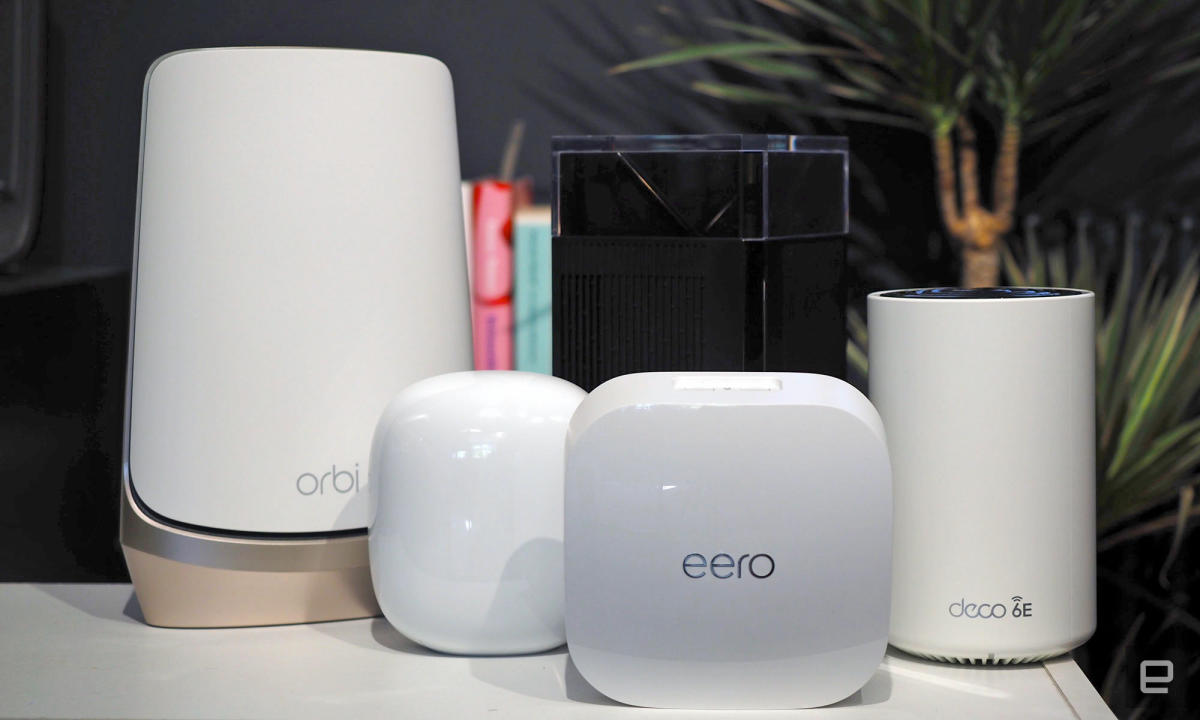
Amazon Eero 6E
On one hand, Eero Pro 6E does count as an “easy” device, the sort you could hand to a total novice and expect them to thrive with. There’s very little brain work needed to get things set up, and the app has a clean UI with plenty of hand-holding. But — and it’s a big but — the fact so many common management tools aren’t available to me here because they’re paywalled irks me. Amazon and Eero are playing in the same slightly shallow waters as Google / Nest, building a “good enough” mesh product for “everyone;” types who want to set up the hardware and more or less forget about it for several years at a time knowing that everything is in hand. But the fact that the Nest WiFi Pro offers more features for free compared to Eero’s package means that, despite my gripes about Google’s system, it wins out in a straight duel.
Netgear Orbi 960
The Orbi 96T0 (RBKE963) is Netgear’s flagship mesh WiFi product, which the company calls the “world’s most powerful WiFi 6E system.” It’s also one of the most expensive consumer-level kits on the market, setting you back $1,499.99 for a three pack. It’s a fantastic piece of gear but it’s worth saying that the subset of people who could, would or should buy it remains far smaller than you might expect. Ultimately, I feel that if you’re paying luxury prices, you should expect a luxury product. There were plenty of times during testing that I went looking for a feature that was either only available via the web client, or behind a paywall. While, yes, much of your cash is going to the superlative hardware, but for this sort of money, the fact you have to pay extra for some table-stakes features is insulting.
[ad_2]
Fonte: